Brasato di Guancia al Barolo con Tajarin al Tartufo Nero
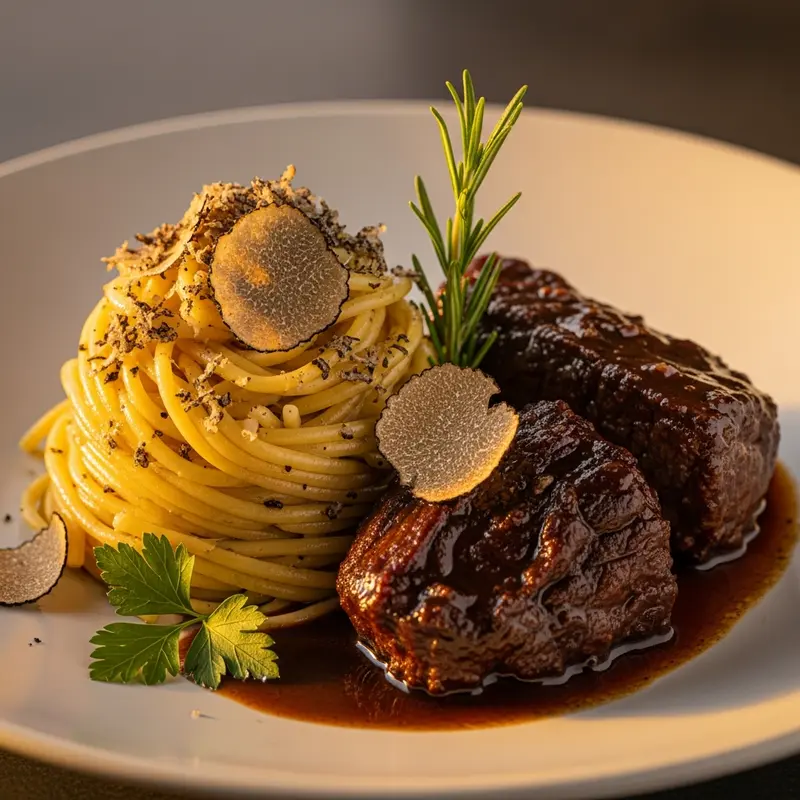
Indulge in a culinary journey to Piedmont with this exquisite Brasato di Guancia al Barolo. Fork-tender beef cheeks, meticulously slow-braised in the opulent depths of Barolo wine, create a ragu of unparalleled richness and complexity. The aroma, a symphony of dark fruit, earthy herbs, and savory beef, promises a deeply satisfying experience. Each bite reveals the tender, yielding texture of the beef, enveloped in a glossy, intensely flavored sauce that coats the palate with notes of plum, spice, and a whisper of umami. This luxurious ragu is then perfectly paired with delicate, golden Tajarin pasta, handcrafted with an abundance of egg yolks for a silken texture, and finished with a generous shaving of fresh black truffle, adding an intoxicating aroma and an elegant, earthy counterpoint to the robust ragu. A true masterpiece of Italian slow cooking.
Gourmet Ingredients
Check ingredients off as you assemble them.
- Beef cheeks1 kg, trimmed of silverskin
- Guanciale100 g, diced
- Carrots2 medium, finely diced
- Celery stalks2 medium, finely diced
- Yellow onion1 large, finely diced
- Garlic cloves4 , minced
- Tomato paste2 tablespoons
- Barolo wine750 ml (1 standard bottle)
- Beef broth500 ml, high quality
- Fresh rosemary sprigs2
- Fresh thyme sprigs4
- Bay leaves2
- Extra virgin olive oil3 tablespoons
- Sea salt1.5 teaspoons, or to taste
- Freshly ground black pepper1 teaspoon, or to taste
- '00' flour300 g, plus more for dusting
- Large egg yolks12
- Fresh black truffle10 g, for shaving (or truffle oil to taste)
- Parmigiano Reggiano50 g, freshly grated, plus more for serving
- Fresh flat-leaf parsley2 tablespoons, chopped, for garnish
Method of Preparation
Follow these step-by-step instructions carefully.
- 1Step 1
Pat the beef cheeks dry with paper towels. Season generously with 1 teaspoon of sea salt and 1/2 teaspoon of black pepper.
- 2Step 2
Heat 2 tablespoons of olive oil in a large, heavy-bottomed Dutch oven or oven-safe pot over medium-high heat. Sear the beef cheeks in batches until deeply browned on all sides, about 3-4 minutes per side. Remove the seared beef and set aside.
- 3Step 3
Add the diced guanciale to the same pot and cook over medium heat until crispy and its fat has rendered, about 5-7 minutes. Remove the crispy guanciale with a slotted spoon and set aside, leaving the rendered fat in the pot.
- 4Step 4
Add the remaining 1 tablespoon of olive oil to the pot if needed. Add the diced carrots, celery, and onion. Sauté over medium heat until softened and lightly caramelized, about 8-10 minutes.
- 5Step 5
Stir in the minced garlic and tomato paste. Cook for 2 minutes, stirring constantly, until fragrant and the tomato paste has deepened in color.
- 6Step 6
Deglaze the pot by pouring in the entire bottle of Barolo wine. Bring to a simmer, scraping up any browned bits from the bottom of the pot with a wooden spoon. Let it simmer for 10-15 minutes, reducing by about one-third.
- 7Step 7
Return the seared beef cheeks to the pot. Add the beef broth, rosemary, thyme, and bay leaves. Ensure the beef is mostly submerged; if not, add a little more beef broth or water. Bring the liquid to a gentle simmer.
- 8Step 8
Cover the Dutch oven tightly and transfer it to a preheated oven at 150°C (300°F). Braise for 3 to 4 hours, or until the beef cheeks are incredibly tender and can be easily shredded with a fork. Alternatively, you can braise on the stovetop over very low heat.
- 9Step 9
While the beef braises, prepare the Tajarin pasta: On a clean work surface, make a mound with the '00' flour. Create a well in the center and add the 12 egg yolks and a pinch of salt. Using a fork, gently whisk the yolks, gradually incorporating flour from the inner edge of the well. Once a shaggy dough forms, begin kneading with your hands for 10-15 minutes until the dough is smooth, elastic, and firm. Wrap tightly in plastic wrap and let it rest at room temperature for at least 30 minutes.
- 10Step 10
After the beef is tender, remove the pot from the oven. Carefully remove the beef cheeks from the sauce and place them on a cutting board. Discard the herb sprigs and bay leaves from the sauce. Skim any excess fat from the surface of the sauce.
- 11Step 11
Using two forks, gently shred the beef cheeks into large, succulent pieces. Return the shredded beef to the sauce. If the sauce is too thin, reduce it over medium-high heat on the stovetop until it reaches your desired consistency, stirring occasionally. Adjust seasoning with salt and pepper to taste.
- 12Step 12
To roll the Tajarin, cut the rested pasta dough into four equal pieces. Work with one piece at a time, keeping the others covered. Lightly flour your work surface and the dough. Using a pasta machine, roll the dough through progressively thinner settings, down to the second-to-last or last setting (typically setting 7 or 8 on a KitchenAid attachment, or similar). The pasta sheets should be very thin and almost translucent.
- 13Step 13
Lightly flour the pasta sheets and let them air dry for 5-10 minutes until slightly tacky but not sticky. Using the tagliolini or thin fettuccine cutter attachment of your pasta machine, cut the sheets into thin strands of Tajarin. Alternatively, roll the sheet loosely into a log and slice very thinly with a sharp knife. Gently unfurl the strands and dust with more flour to prevent sticking.
- 14Step 14
Bring a large pot of salted water to a rolling boil. Add the fresh Tajarin and cook for only 1-2 minutes, as fresh pasta cooks very quickly. It should be al dente.
- 15Step 15
Drain the Tajarin, reserving about 1/2 cup of pasta water. Add the cooked pasta directly to the Dutch oven with the ragu. Add the grated Parmigiano Reggiano and a splash of reserved pasta water. Toss gently to coat the pasta evenly with the rich sauce.
- 16Step 16
Serve immediately in warm bowls. Garnish each serving with a generous shaving of fresh black truffle, a sprinkle of the reserved crispy guanciale, and a pinch of fresh chopped parsley. Serve extra Parmigiano Reggiano on the side.
Chef's Notebook
Your personal cooking adjustments and annotations, saved to this browser.
Recipe Details
Cost Indicator
Gourmet ingredients or slow cooking. Ideal for celebration feasts.